Antisemitism education
Antisemitism, beyond the binary.
Polarization makes antisemitism harder to see, and harder to talk about. After building Project Shema into a national organization, I now help communities, workplaces, governments, campuses, schools, and museums recognize it, respond to it, and talk about it across political lines.
A specialist, not a partisan
I don’t ask anyone to pick a political side. I teach how antisemitism operates, so people on every side can recognize it.
The wider conversation
Antisemitism is woven into a larger human story, shaped by history, identity, belonging, and the ways we make sense of one another.
Understanding it means engaging the broader social, cultural, and historical forces around it, and making room for complexity without flattening differences.
Who I work with
For the people holding the room
Swipe to explore →
Jewish federations & communities
Helping communities respond to rising anti-Jewish harm without letting disagreements over Israel and politics split them apart.
Hillels, universities & campus leaders
Helping administrators, faculty, and students recognize anti-Jewish harm in campus life, respond to incidents, and keep debate open without letting it become harm.
Day schools & K‑12 educators
Supporting teachers, administrators, and parents to address anti-Jewish harm in classrooms, curricula, and school communities, and to answer students’ hardest questions.
Museums & cultural institutions
Helping museums address Jewish identity and anti-Jewish harm in their exhibits and education, and preparing staff and volunteers for visitors’ hard questions.
Workplaces & employee groups
A shared language for recognizing anti-Jewish harm at work, including when it surfaces in conversations about Israel, without ideological litmus tests.
Government & civil society
Helping officials, journalists, and NGO leaders recognize how anti-Jewish harm shows up today, and build policy, coverage, and programs that counter it.
How I approach it
Shared vocabulary, not ideological conformity.
Antisemitism is not a force of nature. People built it, people use it, and people can take it apart. I teach how the machinery works, and how to stop it, without asking anyone to pick a political side.
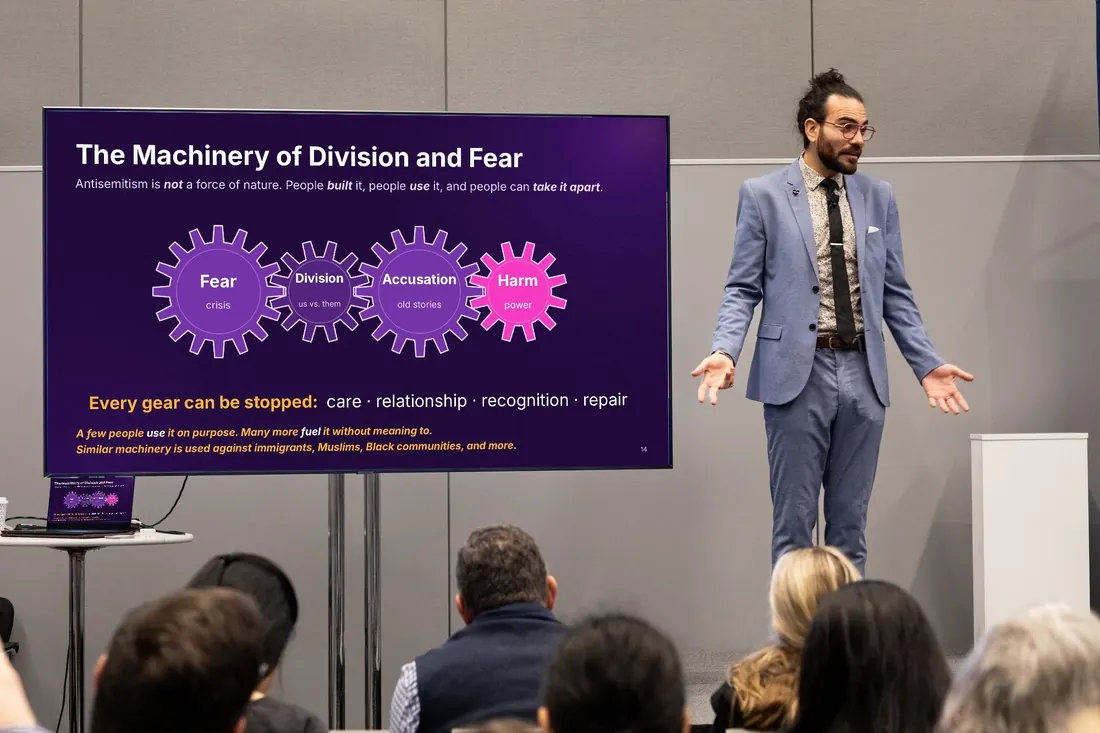
Teach the machinery, not just the hatred.
Antisemitism is both a bigotry and a conspiracy theory, built on four ancient accusations: Jews as Other, Exploiters, All‑Powerful, and Evil.
Recognize it on every side.
These ideas are ideologically promiscuous. They show up on the left, the right, and across traditions, and they harm all of us.
Impact, not intent.
Name anti‑Jewish harm by its effect, not by judging someone’s heart. Then work on repair and safety.
Built on depolarization science.
Research on polarization, conspiracism, and psychology, so people are called in, and the message lands.
In every dark chapter, someone was writing a different story. This chapter is ours.
Where the work is now
From New York to Oslo to Melbourne.
Australia
Australian Jewish Funders
Advising and training to support implementation of the Royal Commission on Antisemitism and Social Cohesion, through workshops, program evaluation, and community strategy.
The Nordics
Compass North
As co‑founder, I advise government, media, and civil society leaders on education and institutional strategy to counter antisemitism and polarization.
United States
Holocaust & Humanity Center
Designing interactive exhibit content, messaging and policy language, and training for staff, board, and volunteers.
Ways to bring me in
From one session to a long‑term strategy
Many communities start with a single workshop. The deepest change comes when a community builds the capacity to carry the work itself.
A workshop or keynote
Dismantling Antisemitism in a Polarized World, my signature workshop, adapted for staff, students, educators, and community audiences.
Training for the people on the front line
Staff, volunteer, and board training: practical preparation for the people who face the public, and briefings for the boards who lead them.
Train-the-trainer intensives
Multi‑day programs that prepare educators, staff, and community leaders to lead this work themselves.
Strategy & program design
Advising organizations building antisemitism education, from curriculum and messaging to fundraising and partnerships.
Crisis response & community conversations
Careful facilitation when an incident has shaken trust, or a community needs to talk across real disagreement.
“Seriously one of the best trainers and facilitators I have ever experienced.”
Vice President, Community & Impact, Jewish Federation
“I came in very skeptical… four hours… I don’t know… but you won me over.”
Senior Administrator, Ivy League university
Simmons University“As a Jewish person and higher education administrator, I have seen many talks on DEI, antisemitism, Israel, etc. This was one of the best!”
Provost, Simmons University
“For a long time I remained silent because I felt afraid, alone, and powerless… Attending your presentation was the first time I no longer felt like I had to live this way, or that I was completely alone.”
Program Officer, philanthropic foundation supporting democracy